Make The Right Call

Launching September 16: New Medical Priority Dispatch System

Calls for Paramedic Services in the Essex-Windsor region will be triaged and dispatched using a cutting-edge Medical Priority Dispatch System (MPDS) beginning on Sept. 16. The new system is designed to ensure that paramedics are dispatched more efficiently, and more quickly, to the most urgent, life-threatening emergencies.

MPDS is a software-based system used by Ambulance Communications Officers to triage 911 calls based on the severity of the medical condition. This system, successfully implemented by the Ministry of Health in several municipalities across the province, is backed by decades of research and evidence and helps Ambulance Communications Officers make more informed decisions.

“MPDS is designed with one clear purpose: to make sure that people experiencing life‑threatening emergencies receive help as quickly as possible,” said Essex-Windsor EMS Chief Justin Lammers. “It helps ensure that someone who is experiencing an urgent or life-threatening event receives an ambulance ahead of someone dealing with a non-urgent, non-life-threatening injury.”

One feature of MPDS is that Ambulance Communications Officers will ask more questions of 911 callers to help determine the urgency of the situation so that ambulances can be sent where they are needed most, when they are needed most.

Because MPDS prioritizes calls based on urgency, patients with non‑life‑threatening conditions will, at times, wait longer for an ambulance — especially during periods when paramedic resources are stretched. Ambulance Communications Officers will remain in contact with these patients to monitor their condition and ensure they can safely wait for care.

“This isn’t a flaw in the system,” said Lammers. “It’s the system working exactly as intended to protect lives and preserve critical paramedic resources for the people who need them most.”

The new system also brings with it changes in terminology. Code Green, when there are 11 or more ambulances, becomes Code Normal. Code Yellow, when there are between four and 10 ambulances, becomes Code Surge. Code Red, when there are between one and three ambulances, becomes Code Critical. Code Black, when there are zero ambulances, becomes Code Zero.

Read a Council report on the launch of MPDS!

View the presentation on MPDS made to Council!


Medical Priority Dispatch System: Frequently Asked Questions

The Ontario Ministry of Health is launching on September 16 the Medical Priority Dispatch System for medical 911 calls in Windsor and Essex County.

The new evidence-based system will help Ambulance Communications Officers more accurately assess each patient’s condition and prioritize paramedic responses based on medical urgency.

The Ontario Ministry of Health is launching on September 16 the Medical Priority Dispatch System for medical 911 calls in Windsor and Essex County.

The new evidence-based system will help Ambulance Communications Officers more accurately assess each patient’s condition and prioritize paramedic responses based on medical urgency.

What is the Medical Priority Dispatch System?

The Medical Priority Dispatch System, or MPDS, is a software-based system used to assess and prioritize medical 911 calls.

Ambulance Communications Officers will follow a structured series of medically approved questions to determine the nature and severity of a patient’s condition. This will help ensure the most appropriate paramedic resources are sent to the patients who need them most urgently.

MPDS is supported by decades of medical research and is used in ambulance communications centres across Ontario and around the world.

The system currently used to prioritize ambulance calls can assign a high-priority response to patients whose conditions are not life-threatening. This means paramedics may be responding with lights and sirens to a less urgent call when a patient with a life-threatening emergency needs them.

MPDS provides a more accurate and clinically supported assessment of each call. Its primary purpose is to ensure patients facing the most serious and time-sensitive medical emergencies receive the fastest possible response. It has been successfully implemented in multiple municipalities in Ontario.

MPDS is scheduled to be launched on September 16.

The local transition was originally scheduled for February 2027, but the Ministry of Health moved it forward following advocacy by Essex-Windsor EMS and the County of Essex.

The Windsor Central Ambulance Communications Centre is operated by the Ontario Ministry of Health. Its Ambulance Communications Officers answer medical 911 calls and dispatch Essex-Windsor EMS paramedics.

Essex-Windsor EMS delivers paramedic services, but the Ministry-operated communications centre is responsible for receiving, assessing and prioritizing medical calls and dispatching ambulances.

Callers may be asked more detailed questions about the patient and their condition. These questions are necessary to accurately determine the urgency of the situation and what type of response is required.

Callers should:

  • Stay calm and remain on the line.
  • Clearly provide the exact location of the emergency.
  • Answer each question as fully and accurately as possible.
  • Follow any instructions provided by the Ambulance Communications Officer.
  • Be prepared to repeat information to different emergency responders.

Answering these questions does not mean the call is being ignored. In the most serious emergencies, resources can be dispatched while additional information is being gathered.

Yes. Every medical 911 call will continue to be assessed, and patients who require paramedic care will still receive it.

When paramedic resources are available, lower-priority calls can be dispatched without delay. When demand is high, however, patients with non-life-threatening conditions may wait longer while paramedics respond to more urgent emergencies.

At times, yes.

When the system is busy, patients with less urgent conditions may experience a longer wait. This allows available paramedics to respond first to patients experiencing cardiac arrest, severe breathing difficulties, unconsciousness, major trauma or another life-threatening emergency.

A longer wait does not mean a call is unimportant or that the patient will not receive care. It means other patients in the community have been assessed as having a more immediate, life-threatening need.

Ambulance Communications Officers will monitor delayed calls and may call back to determine whether the patient’s condition has changed.

If the patient’s symptoms suddenly worsen or new symptoms develop, call 911 again immediately. Provide the updated information so the call can be reassessed and, if necessary, assigned a higher priority.

Do not wait for a scheduled callback if the situation changes.

Yes. An available ambulance may be redirected if a more urgent, life-threatening emergency occurs before the paramedics arrive at the original call.

If that happens, the lower-priority call will remain active and another appropriate paramedic resource will be assigned as soon as one becomes available.

MPDS is expected to:

  • Prioritize the most serious and time-sensitive medical emergencies.
  • Improve the accuracy and consistency of dispatch decisions.
  • Make better use of available paramedic resources.
  • Reduce unnecessary lights-and-sirens responses.
  • Improve road safety for paramedics, patients and the public.
  • Help preserve ambulances for patients whose lives may depend on an immediate response.

No. MPDS is a new way of assessing calls and assigning existing paramedic resources. It does not reduce Essex-Windsor EMS staffing or the number of ambulances deployed in the community.

It is intended to make better use of those resources, particularly when several calls occur at the same time or demand exceeds the number of immediately available ambulances.

Yes. If you believe someone is experiencing a serious or life-threatening emergency, call 911 immediately.

Examples may include:

  • Cardiac arrest or unconsciousness
  • Difficulty breathing or choking
  • Persistent chest pain or pressure
  • Signs of a stroke
  • Severe bleeding
  • A severe allergic reaction
  • Serious injury or trauma

This is not a complete list. Do not avoid calling 911 because you are uncertain about how the call will be prioritized. Ambulance Communications Officers are trained to assess the situation based on the information you provide.

911 should be used for emergencies. For non-emergency health concerns, options may include:

  • Calling Health811 by dialing 811.
  • Contacting a family doctor or nurse practitioner.
  • Visiting a walk-in clinic or urgent-care centre.
  • Speaking with a pharmacist.
  • Calling 211 for information about local health and community services.
  • Calling or texting 988 for suicide-crisis support.

If you are unsure whether a situation is an emergency or believe someone may be in immediate danger, call 911.

Not necessarily. Hospitals assess all arriving patients according to the seriousness of their medical condition, regardless of whether they arrive by ambulance or another means.

Calling an ambulance should not be used as a way to bypass the emergency department waiting room.

No.

Next Generation 911 is a broader technological modernization of the 911 system, including improvements to how emergency information is transmitted and shared.

MPDS is the medically based system Ambulance Communications Officers use to question callers, assess the seriousness of a patient’s condition and prioritize the paramedic response.

Text 911

Services for the Deaf and those with hearing issues

Text 911 is a service available to you if are Deaf, hard of hearing or speech impaired. You must be registered in order to use the service. Click the link below to learn more!

When you call 911 for a medical emergency, Essex-Windsor EMS ambulances respond and time is of the essence. That is why it’s important to call only in emergencies and look for other options when a health-care crisis doesn’t require immediate attention. Call 911 when an injury or illness could cost someone’s life or ability to function without rapid medical intervention.

Some symptoms for which you should call 911

  • loss of consciousness
  • sudden confusion, trouble speaking, dizziness
  • persistent, severe chest pain
  • sudden breathing difficulty or shortness of breath
  • fractured or broken bones
  • uncontrolled bleeding
  • a sudden, severe headache or vision problems
  • sudden weakness, numbness and/or tingling in the face, arm or leg
  • sudden severe pain
  • severe burns or allergic reactions

Essex-Windsor EMS works closely with the Central Ambulance Communications Centre, local hospitals and other responders to ensure ambulances are available when emergencies happen. When ambulances are tied up with non-emergency calls, this becomes more challenging. How can you help ensure paramedics will be available to attend to the most seriously ill and injured?

Here are options you can use for a non-emergency health crisis:

  • Contact your doctor or go to a walk-in clinic. Find your nearest clinic.
  • Visit Health811 or call 811 to talk to a registered nurse 24 hours a day, 7 days a week. You do not need to provide your OHIP number and all information is confidential.
  • Set up a virtual appointment with a physician using the Urgent Care Ontario website, a service available to residents of Southwestern Ontario. You can also call 1-844-227-3844.
  • Call 211 to find out about health care services in Windsor and Essex County.
  • Learn where the Mobile Medical Support team will be next by visiting the Windsor-Essex Ontario Health Team website.
  • Use alternate transportation to go to a hospital emergency room.

Essex-Windsor EMS is encouraging residents to Make The Right Call by following the advice of health-care professionals and taking appropriate actions when they experience health-care crises.

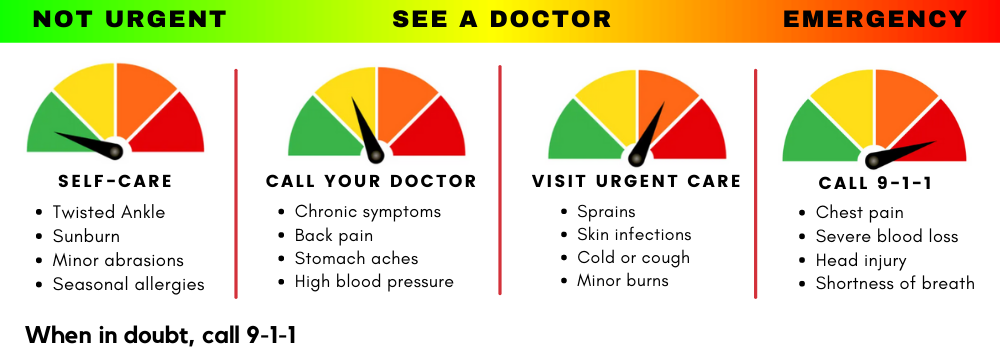
A graphic showing increasing levels of urgency for a health crisis. It ranges from issues that can be remedied with self care to those that require a doctor to emergencies when you should call 911. When in doubt, call 911.

What's new

Watch here for updates about what we are doing and important messages for the community.

Survivor Day Celebrates Lives Saved in 2024 (May 23, 2025)

Essex-Windsor EMS Paramedic Recognized by Trillium Gift of Life Network (April 24, 2025)

Essex-Windsor EMS Operational Update to Essex County Council (March 19, 2025)

Updated Essex-Windsor EMS Master Plan Presented at Essex County Council (Feb. 5, 2025)

Public Thanked for Helping Register More Than 1,000 AEDs (Dec. 3, 2024)

Contract Awarded for Essex-Windsor EMS Fleet Maintenance (County Council Highlights for Nov. 6, 2024)

Purchase of Seven New Ambulances Approved for 2026 (County Council Highlights for Nov. 6, 2024)

Regional Health Care Partners Working Together to Prepare for High Seasonal Volumes (Nov. 4, 2024)

Land Ambulance Response Time Performance Plan (Essex County Council Highlights for Sept. 18, 2024)

2025 Pre-Budget Stretcher Procurement Approval (Essex County Council Highlights for Sept. 18, 2024)

Mid-Year Status Update to Essex County Council (July 17, 2024)

Essex-Windsor EMS Welcomes 20 New Paramedics (May 31, 2024)

Survivor Day Celebrates Lives Saved in 2023 (May 24, 2024)


Contact Essex-Windsor EMS

Call our administration office: 519-776-6441  ext. 2656

For news updates go to our Make The Right Call page.

Stay Informed

Subscribe to receive email notifications of our news notices and announcements.